A biography in six parts · Barcelona, 1982 – today
Go broke. Get up. Build again.
The life of Sergi Rodríguez Zambrana, a Barcelona developer who went by spnfury online and now works as Sergio de la Rosa. Twenty years of starting companies in Spain: some were sold, some went into insolvency, and a few are still running.
Rebuilt from his 2007–2024 blog (recovered from the Wayback Machine), Spain’s Companies Register, press coverage, his social accounts and the code of his projects. Every source is linked; most are in Spanish, and quotes are translated. Leer en español
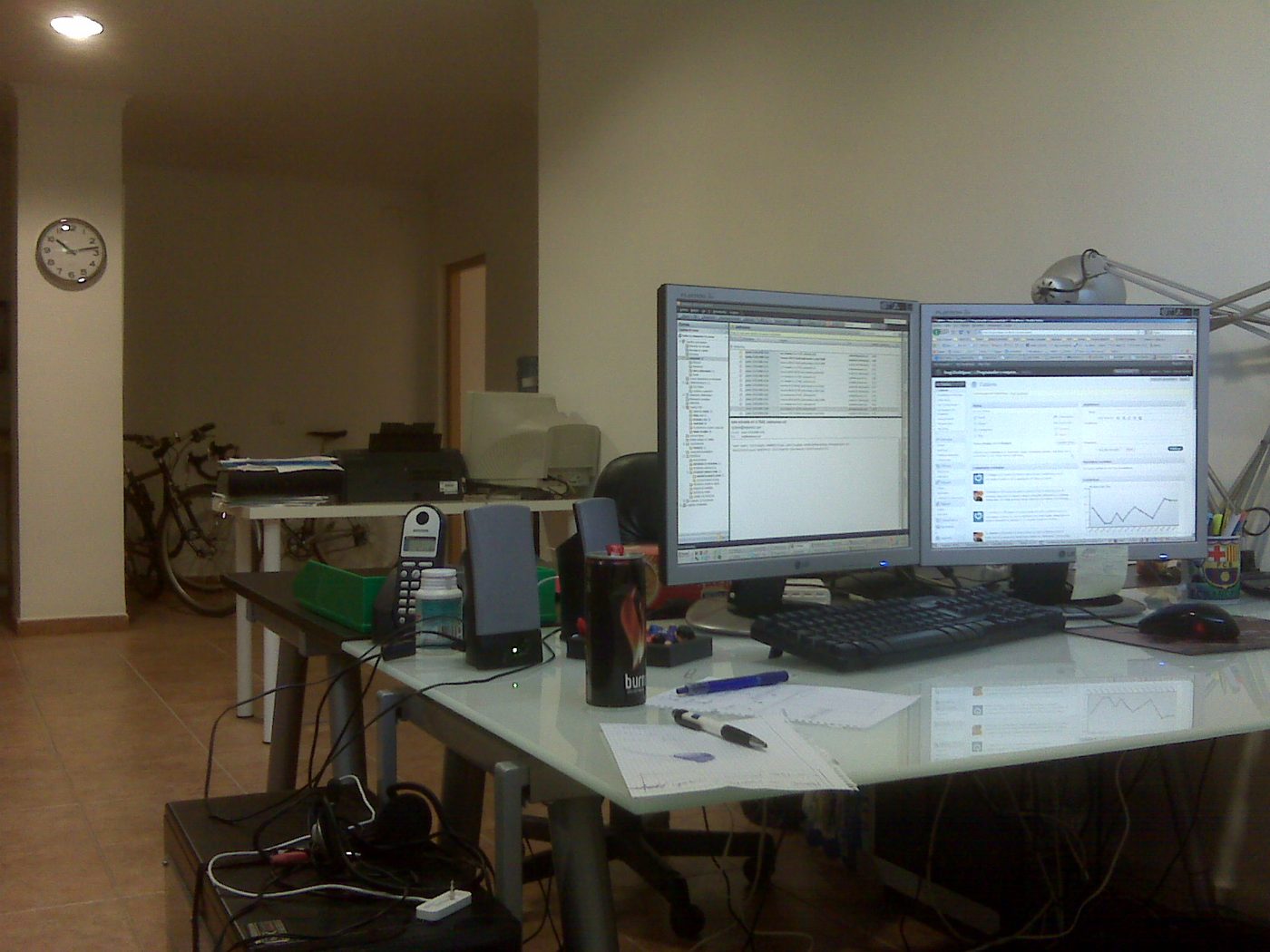
Barcelona, 17 May 2009. His desk at the new office on Carrer de Llull, in the city's 22@ tech district, a month after launching Oooferton. He took it on a BlackBerry.
The rollercoaster
The map before the journey. Each point is a real moment in the story. Height isn’t money or revenue: it’s how life was going, up or down, judging by what he wrote at the time.
12005Stuck on €1,000 a month
22007Buys 50% of Desig
32008Casinuevo turns a profit
42009Oooferton: €100k a month
52010Forced to sell his 21%
62011Eighteen months of silence
72012Onyougo live in 16 countries
82014Accelerator and a funding round
92015Desig goes insolvent
102015“So long without direction”
112017Co-founds Garantify
122018Garantify: 1,547 agencies
132020Shopipay for Shopify
142022A crypto fund and ShopWin
152023Traffic drops, ad income drops
162024Sergio de la Rosa is born
172025Tells it all on a podcast
182026Fifteen products at once
Amber: above the starting point. Red: below it.
I
Part I · The ordinary world · 1982–2006
A kid who could code, and a pay packet that didn't go far
Every hero starts somewhere ordinary. For Sergi it was a computer lab in Barcelona and an entry-level salary.
Chapter 1 · 1982 – 2004
Learning the internet by reading other people's code
Sergi Rodríguez Zambrana was born in 1982 near Barcelona. The urge to sell came before the computer:
“What I’ve always loved is the hustle, buying and selling. I was selling at school from the age of seven: my dad photocopied Dragon Ball comics for me and I sold them in the playground. I bought sweets with the money, and a lot of the time I reinvested it in stock.”
He belongs to the generation that got online through a screeching dial-up modem and learnt HTML by hitting “view source” on other people’s websites. Years later he’d sum it up as “I lived the internet from the very beginning.”
After a technology-track high school, he took two higher vocational diplomas in IT (roughly what a TAFE diploma is in Australia, or an HND in the UK): systems administration at the Escola del Clot, then software development at IES La Ferreria in Montcada i Reixac. Later he added courses at EAE Business School.
By 19 he was already coding for clients. In 2001 he built the first version of oh-holidays.com, a travel portal. On LinkedIn he described it modestly, with no idea that travel would shape his first decade in business: “I developed the first version of this portal as its programmer.”
Then came the ordinary jobs. An internship and then a network technician role at Grupo Kalise Menorquina, a Spanish ice-cream maker. A few months freelancing for Serveis Informàtics Barcelona, building around five complete websites on his own. Then a developer role at Open House Spain.
In mid-2000s Spain there was a word for people like him: mileurista, someone with qualifications and talent stuck on about €1,000 a month. It’s the part of the story almost nobody tells, and it explains everything that follows: a young developer with real skill, a tight salary and the feeling that he was building things for other people.
“I started out humbly, like most people with a regular job: yes, a mileurista. I soon realised that wasn’t going to get me anywhere.”
He had two things going for him. He coded fast, and he’d picked up a skill that very few people had mastered in 2005: getting a website to the top of Google. His profile at the time listed “programming, design, online marketing and organic search”. That skill would become his first real advantage.
Sergi in 2009, aged 26. Portrait published with his BrandeaStudio interview.
II
Part II · The call to adventure · 2006–2008
Mortgaging the flat and crossing the threshold
The opportunity arrives dressed as a risk: stop being an employee and buy half the company, with money he doesn’t have.
Chapter 3 · 2006 – 2010
Desig Barcelona: the bet of his life
In June 2006 Sergi joined the Desig group as a project manager. It was a small holiday-apartment agency with an office on Carrer de Mallorca in Barcelona, and its website, desigbarcelona.com, offered “more than 200 tourist apartments in Barcelona and Sitges”. His brief was the thing he did best: get it found on Google.
He gave himself a year to reach the top results. It took nine months. “After nine months we’d had spectacular results for ‘apartamentos barcelona’ on google.es.”
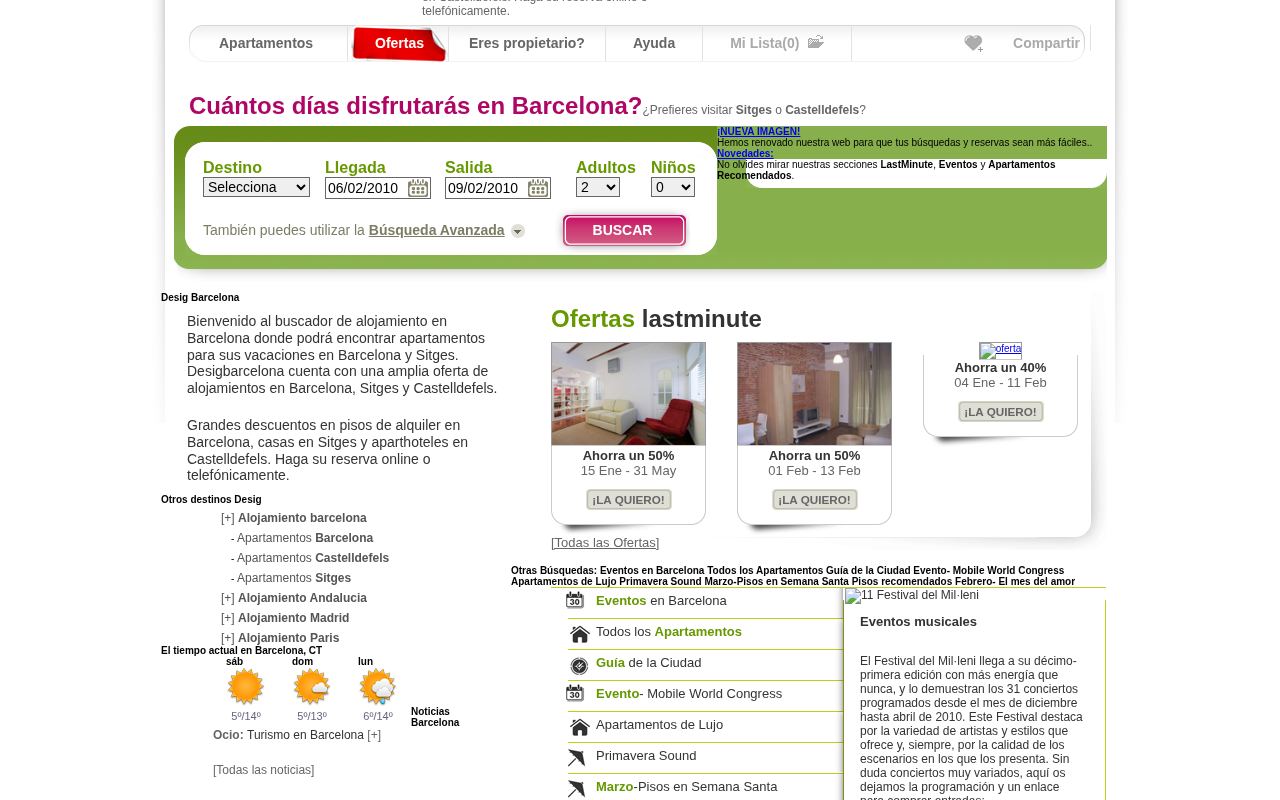
desigbarcelona.com6 Feb 2010
Desig Barcelona in February 2010, a month before the best March in its history: an apartment search, last-minute deals and links to Paris, Madrid and Granada.
Then came the call. The owners offered him half the company. He didn’t have the money. Years later his business partner Daniel Rodríguez Arias told Spain’s national news agency, EFE, that Sergi “had the chance to buy 50%… he mortgaged his flat, took out a loan and bought it”.
“Within a year I’d bought half the shares and become a business owner almost without thinking about it.”
With his 50%, Sergi ran Desig the way he knew from search: one website per city, each in four languages (Spanish, English, French and Italian), backed by a network of satellite blogs to push them up the rankings. By July 2008 the group had Desigbarcelona, Desigmadrid, Desigparis, Desigbuenosaires, Desigandalucia (Granada) and Desiginvestment, for property investment in Argentina.
By 2009 the company had eight people. In March 2010, with Spain deep in the financial crisis, he wrote that it was “on track to be the best month in the company’s five-year history, in revenue and bookings, and that’s while they say we’re in a crisis”. They added Valencia, Rome, Berlin and London, a German-language site, live chat with guests and a partnership with the travel site minube.com. In September 2010 he chaired the opening panel at COMITUR, a tourism marketing conference in Lloret de Mar, alongside people from Yahoo and Grupo ITnet.
He’d later call it “apartment dropshipping”: Desig didn’t own the flats. It supplied the search traffic and the customer service, and kept 25% of every booking. At its peak it turned over €60,000–70,000 a month, at a 25–30% margin. “I loved the apartments business because it was pure: there are no faulty products.”
of Desig, bought with a mortgage
50%
of Desig, bought with a mortgage
cities: BCN, Madrid, Paris, Buenos Aires, Granada, Rome, Berlin
7
cities: BCN, Madrid, Paris, Buenos Aires, Granada, Rome, Berlin
While he grew Desig by day, at night he coded something of his own: casinuevo.net, a free classifieds site (think Gumtree or Craigslist, for Spain). The first test listings date from August 2006. The earliest Wayback Machine capture, from August 2007, shows a beta with six ads.
“In my spare time I worked on my free classifieds site. Over time, and after putting in a lot of hours, it started making a decent profit.”
He used the same playbook as at Desig. In September 2007 he boasted of getting “second-hand ads” to number 7 on Google in a single week. By January 2008 the site had 1,153 listings. That October he set up his second company, Cyberworld Networks S.L. (an S.L. is a Spanish private limited company), as sole founder, and launched versions for Mexico (Avisosderemate.com, Casinuevo.com.mx), Latin America (1000avisos.com), Peru and Ecuador.
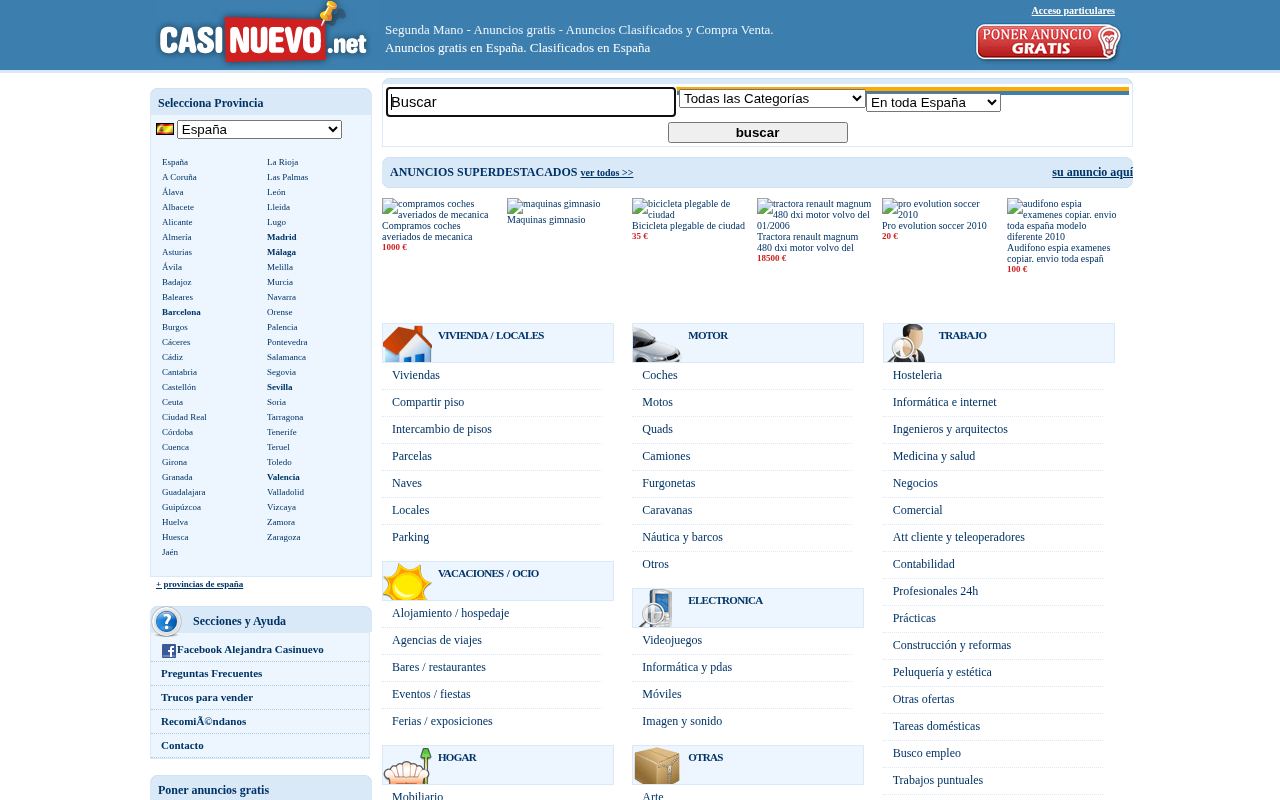
casinuevo.net11 Jun 2010
Casinuevo.net in June 2010: free ads by category and province. In the footer: “Copyright Cyberworld Networks, S.L. · Webmaster: Sergi Rodríguez”.
In December 2008 he did something that didn’t come naturally: he stepped out from behind the screen. He went to his first Iniciador Barcelona, a grassroots meetup for Spanish internet founders, with the investor Rodolfo Carpintier as guest speaker. “I’m honestly not one for writing, or networking, or opening up at these events… but it was time to change and put myself out there a bit.” He was asked to play the SEO “expert” in a group exercise and admitted his mind went blank. He went back anyway, and in 2009 confessed: “I’ve gone from never going to these events to being hooked; it’s like a small drug.”
In February 2009 he tweeted from a trip to Ecuador. His Twitter bio read “Webmaster – Entrepreneur”. He coded in an office on the Rambla del Poblenou, “drinking a Red Bull and coding flat out”, and swore at Zend Studio for crashing for the fourth time. He was 26 and running two companies.
With Spain in recession, Sergi does the opposite of everyone else: he speeds up. He lands his biggest success and loses it almost at once.
Chapter 5 · 2009
Oooferton: Spain's first one-deal-a-day site
In late 2008 he met Luis Krug, who had come from the German electronics retailer redcoon.com. Sergi showed him Casinuevo’s numbers and Krug pitched an idea: a site that sells a single product a day, at a rock-bottom price, for 24 hours only. Woot in the US, iBood in Europe. In 2009 the format was called live shopping.
“For a lot of people 2009 is a year to just hold on because of the crisis. I see it as a year of opportunities.”
On 29 April 2009 oooferton.com went live, with three O’s. It billed itself as “the first Spanish live shopping site: one product, one day”. Sergi was co-founder and CTO, and also the entire tech team: “I don’t have anyone under me doing development, so in the end I have to do most of it myself.”
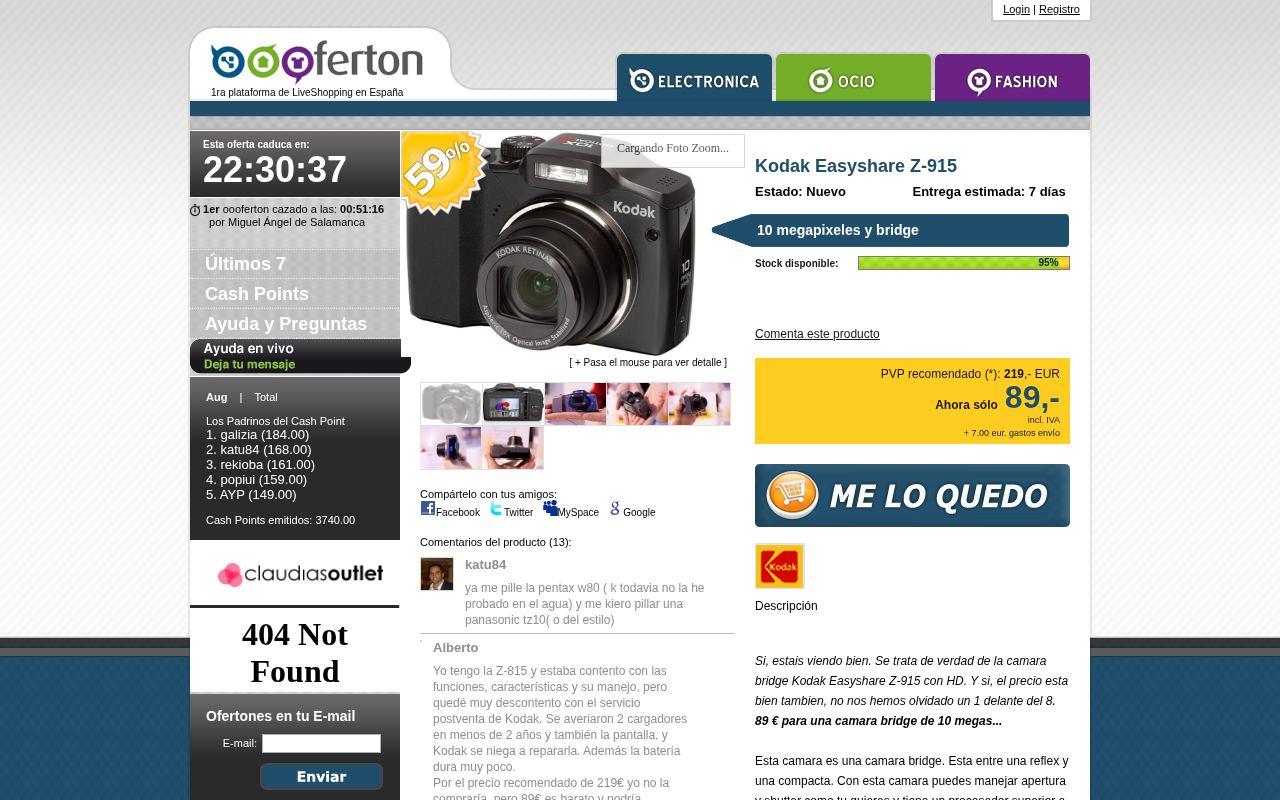
oooferton.com17 Aug 2010
Oooferton in August 2010: a Kodak camera, a countdown clock and a button that says “I'll take it!”. One deal, one day.
It grew fast. In May they moved into a “much bigger” office at Carrer de Llull 393, next door to Iniciador. Sergi recruited PHP developers on Twitter. In July, back from a short break in Tenerife and running on almost no sleep, he recorded an interview on a Madrid stopover with Rodolfo Carpintier for Baquía TV, the video channel of the Spanish tech news site Baquía. It ran in three parts: “People still want the latest products, just cheaper”, “We think live shopping is going to work well in Spain”, “A call centre would make buying easier”.
In August they opened a warehouse. “Not only are we not closed for August, we’re open THROUGH the holidays.” (In Spain, much of the country shuts down for August.) In October he tweeted: “265 confirmed orders on oooferton in one day, a total success.” Another Saturday: “wrecked, 14 hours’ work on a Saturday… but the oooferton carousel was a huge success.”
monthly revenue after 8 months
€100k
monthly revenue after 8 months
orders in a single day, Oct 2009
265
orders in a single day, Oct 2009
registered users, Feb 2010
200,000
registered users, Feb 2010
average growth every six months
+80%
average growth every six months
Figures Sergi published on his own blog in December 2009 and February 2010. In 2025 he put it this way: “between €100,000 and €150,000 a month, but on a much thinner margin, 10 to 15%.”
By the end of 2009 Sergi was running three companies “that have very little in common”: Desig, Cyberworld Networks and Oooferton. And he was still preparing the most ambitious one yet. In August he described it without naming it: “almost a year’s work… a far more ambitious project than its little brother casinuevo… the first project I’ve launched without writing the code myself”.
“Can we call it a success? Obviously not, not until it earns and grows. But it’s deeply satisfying to build something exactly the way you pictured it. I felt a bit like a film director.”
Cladoo was meant to be a global, multilingual classifieds site: general-purpose, but with the depth of a specialist one. The goal was to “multiply by 200” Casinuevo’s traffic. On 24 November 2009 he presented it to Latin America on a livestream, “a bit nervous”. Loogic, the go-to blog for Spanish startups, covered it: “Cladoo, the new classifieds project from the founder of casinuevo.net.”
cladoo.com16 Mar 2010
Cladoo, the classifieds site that wanted to go global. In January 2010 Sergi took over the code again himself: “I'm taking the reins of Cladoo”.
On 4 January 2010 he wrote his resolutions: quadruple revenue across every company, grow the team, launch spin-offs of the businesses and “find an investor”. He signed off: “AN EXCITING 2010.”
He wasn’t looking for an investor but for someone like him, “keen to keep making the site bigger… because this project is going to be huge”. On 26 March he signed the sale: “I am officially leaving oooferton.”
oooferton.com11 Jun 2013
Oooferton in 2013, without him: TV giveaways, sponsoring Spain's eShow ecommerce fair and millions in revenue. “This project is going to be huge”, he'd written when he sold.Oooferton TV ad (OfertonTV channel) · 2011 · the brand he helped build, now on television
But his blog post that same day isn’t a sad one. It’s one of the brightest things he ever wrote:
“I’m much more relaxed, spending more time on leisure, sport, going out… Funnily enough, that free time is when I’ve had my best ideas. Enjoy life, do the things that fulfil you and make you laugh, be happy, and your work will go far better for it.”
That month Desig broke its record, Cyberworld’s ad income rose by more than 200% and Cladoo grew 90%. In May he launched a blog network with a partner (mundial-noticias.com, conducemotor.com, misdocumentales.com, siervogeek.com, gran-hermano-noticias.com) and closed a sale of Cladoo shares. In April he flew back to Tenerife to meet a potential investor “who could give me the capital and resources to take the projects global”.
The years in which he climbs highest in the startup world and falls lowest in his own life. All within the same eighteen months.
Chapter 8 · 2011
Silence
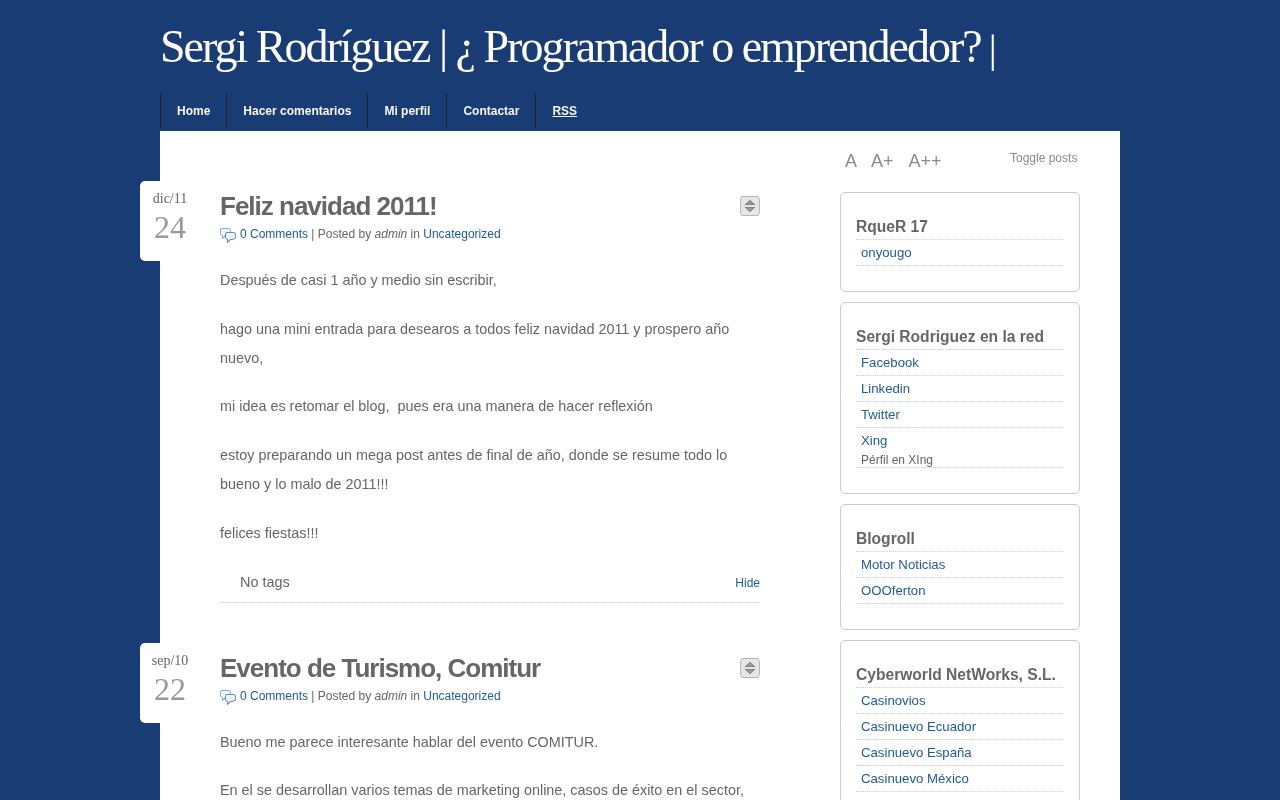
The blog went quiet for a year and a half. At Christmas 2011 a short post appeared: “After almost a year and a half without writing… I want to get back to the blog, because it was a way of reflecting.” He promised a big post on “all the good and the bad of 2011”. It never came.
He kept moving in the meantime. At an Iniciador event he met Daniel Rodríguez Arias, an entrepreneur from Valencia. Daniel would later say what they shared was refusing to settle for “a permanent job, an eight-hour day and never getting to use what we’re capable of”. In April 2011 they founded R Que R 17 S.L. together, later renamed Onyougo Dreams. In July, with Daniel and his former partner Luis Krug, he set up Diva Loca S.L., an online sports and clothing shop that lasted until 2013.
sergirodriguez.com8 Feb 2012
His blog, “Sergi Rodríguez | Programmer or entrepreneur?”, in February 2012: the Christmas 2011 greeting sitting on top of the COMITUR write-up from 2010. Fourteen months between the two posts.
His Twitter filled up with runs around Montjuïc logged on RunKeeper. In August 2012: “15.79 km – trying out long distance.”
Chapter 9 · 2012 – 2016
Onyougo: three lives of the same idea
“How often do we walk into an electronics store and end up buying whatever the sales assistant recommends? That question is where Onyougo was born.”
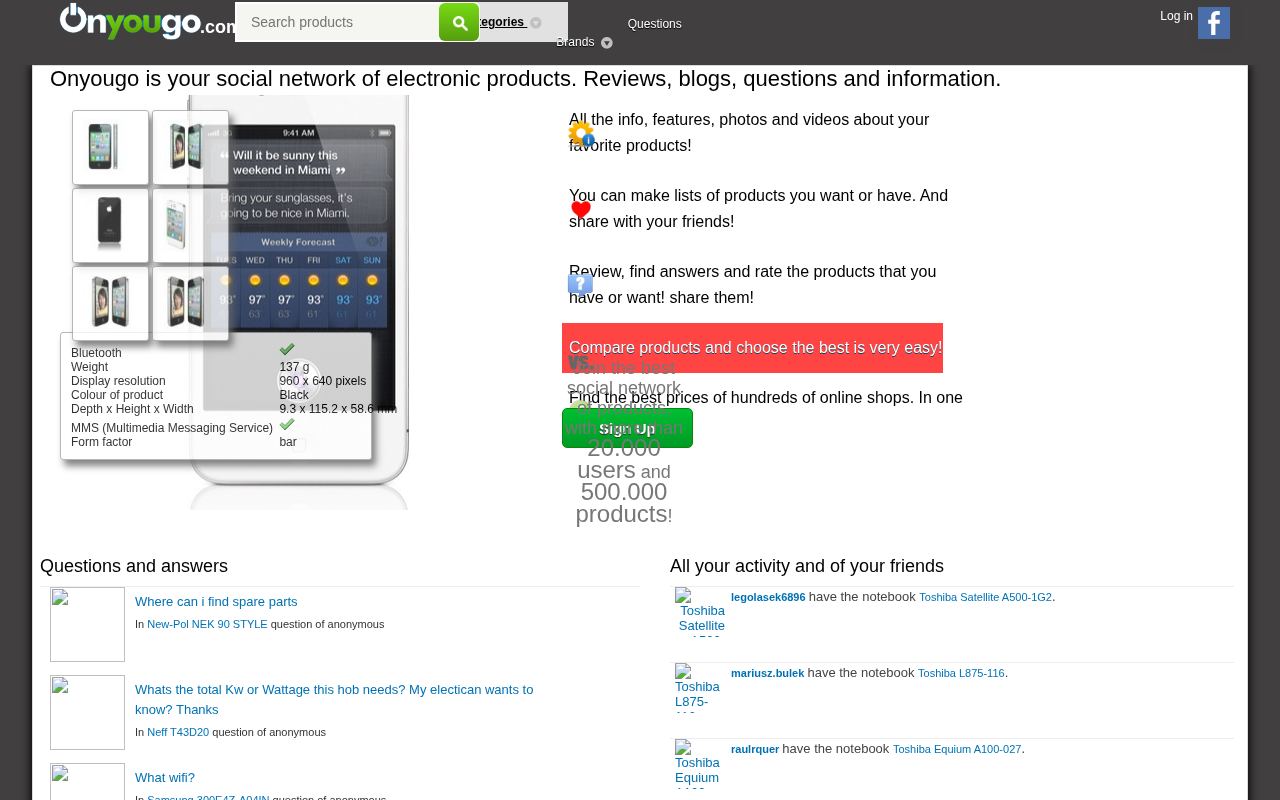
First life (2012): a social network for products. Lists of what you own and what you want, reviews, and questions to your friends. “Right now there are two of us on board: Daniel Rodríguez Arias and me.” In November 2012 they announced the UK, Romania, Saudi Arabia, Sweden, Poland and a Catalan version: 16 countries, 20,000 users and 50,000 daily visits across the network.
onyougo.com3 Dec 2012
Onyougo in its first life: a social network for deciding what to buy based on what your friends think.
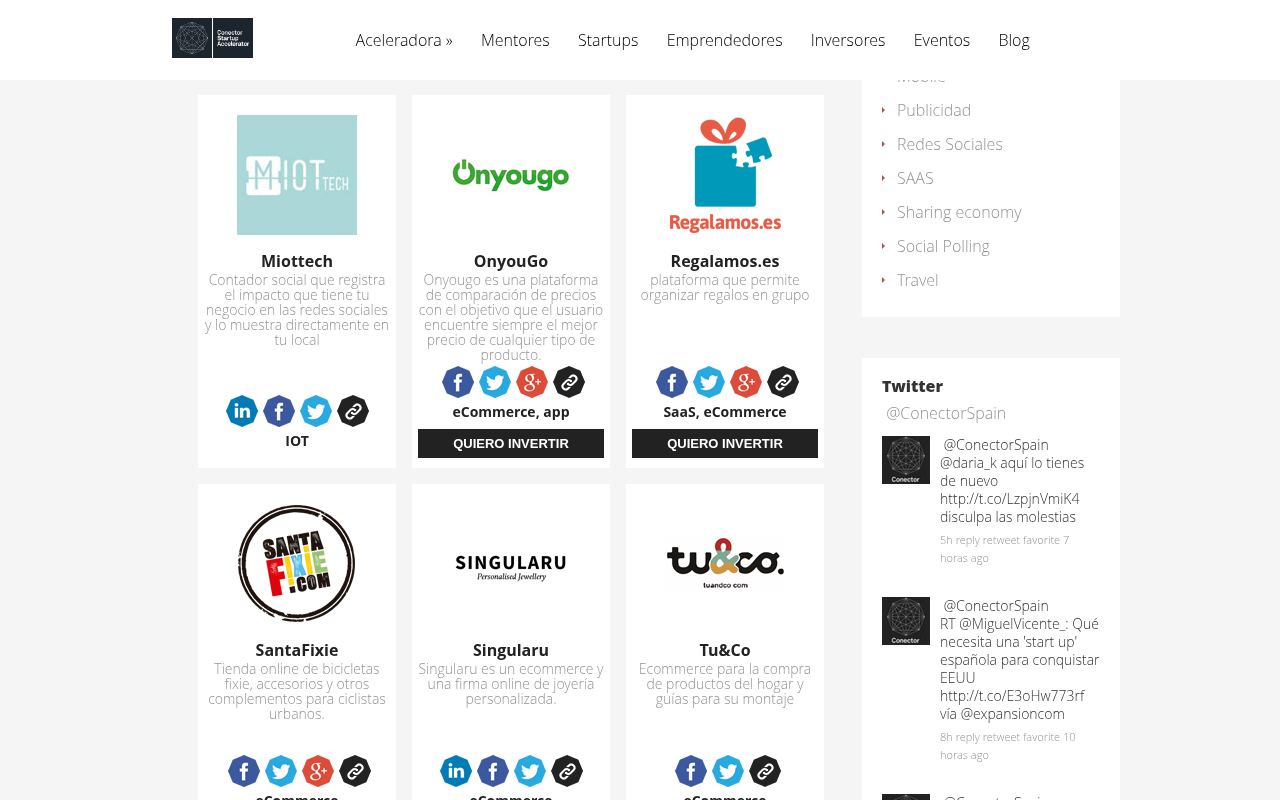
Second life (2013–2014): a price comparison site. 2014 brought its most visible moment. Onyougo was picked, “from more than 150 projects”, for the second intake of Conector Startup Accelerator in Barcelona. Conector was Carlos Blanco’s accelerator, a mentor-led programme along the lines of Techstars, and its partners included Risto Mejide (an ad man best known in Spain as a famously blunt TV talent-show judge), Marc Ros, Xavier Verdaguer and Miguel Vicente, co-founder of Letsbonus (Spain’s Groupon-style deals site) and Wallapop (its leading second-hand marketplace app). Onyougo’s mentors were Axel Serena, Marc Ros and David Tomás.
That cohort was a lucky one. The same intake, Barcelona #2, included Kompyte, which Semrush bought in 2022 for US$10 million. Glovo, the delivery app, joined the next one. Sergi shared corridors, mentors and a Demo Day with those teams.
conector.com/aceleracion-startups/barcelona-22015
Conector's Barcelona #2 cohort: OnyouGo alongside Kompyte, Singularu, Zizerones, eSportics and Regalamos.es.
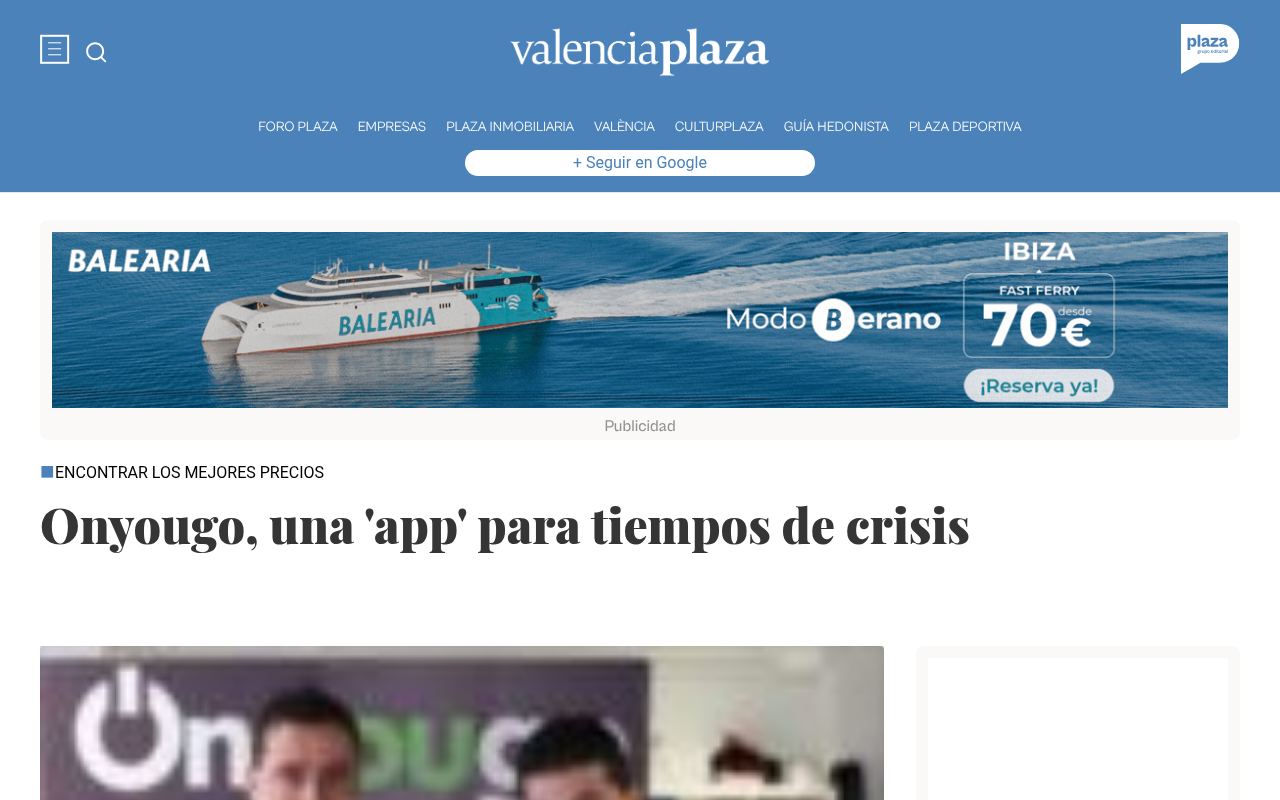
In November 2014 they launched a “free, collaborative and unbribable price comparison site”: more than 1,200 shops in 16 countries, none of them able to pay for a better position. In March 2015 EFE ran a feature on the “app for hard times”: scan a barcode in a shop and it tells you where the product is cheaper, across 80,000 shops and 19 million products.
On 17 April 2015 they closed a €100,000 round led by the Antai fund, with angel investors Marc Ros, Risto Mejide, Axel Serena, Vicente Alán and Carlos Blanco.
projects competing for a place at Conector
150+
projects competing for a place at Conector
round with Antai and Risto Mejide, 2015
€100k
round with Antai and Risto Mejide, 2015
products to compare in the app
19M
products to compare in the app
countries with their own version
16
countries with their own version
valenciaplaza.com1 Mar 2015
“Onyougo, an app for hard times”. The EFE feature that told the two partners' story, including Sergi's mortgage to buy into Desig.
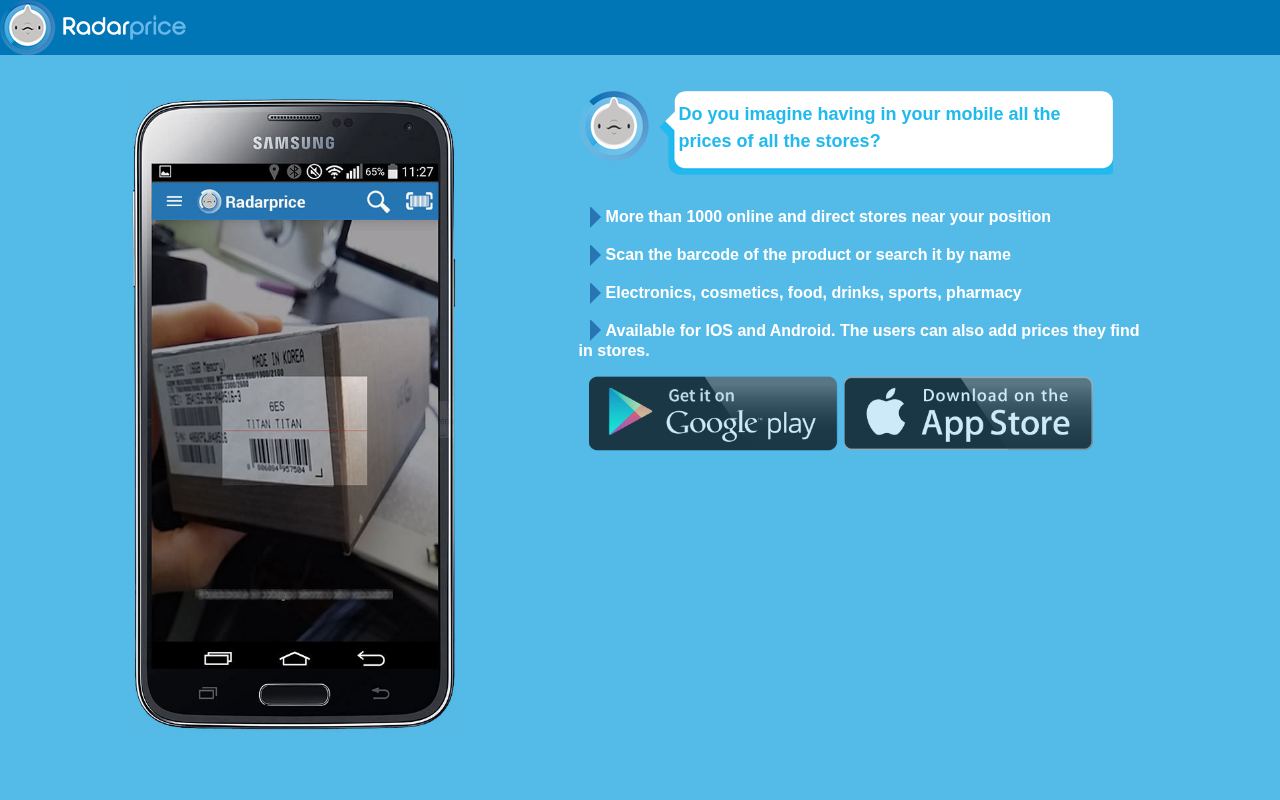
Third life (2015–2016): Radarprice. In August 2015 they rebranded as Radarprice and reported more than 10,000 users in three months. Ten years later Sergi would recall the most expensive lesson: “we started by going after every product, more than 8 million listings, in every country. We spent more than €6,000 on domain names alone.” When they narrowed down to a single category, baby nappies, the recognition came: App of the Week on the App Store. “Things started going well when we found our niche.” It wasn’t enough to save the company. In January 2016 Sergi stepped down as a director. The last version of the app shipped in August 2016 and the company went into liquidation in 2018.
radarprice.com8 Oct 2015
Radarprice in October 2015: scan a barcode in a shop and the app tells you if it's cheaper elsewhere, online or around the corner.Radar Price pitch at BizBarcelona · 2 June 2016 · presented by his partner Daniel Rodríguez, CEO (in Spanish)
While Onyougo was making the papers, the thing he had built before was falling apart.
In March 2014 he explained why he’d stopped writing: “being in a relationship always makes you settle down a little, and you grow in other ways, mostly personal ones.” He retreated to the one thing that had always kept him afloat, Casinuevo. “I’m focused on making casinuevo.net great again.” In April 2014 he announced they had “put an end to fraud” by verifying users by phone.
And in October 2015 he published the shortest and most honest post in seventeen years of blogging:
“After so long without direction, I’m motivated again. With a muddy, clouded mind it’s impossible to move forward; I’ve had to suffer a lot to reach this point of peace. I’m not AFRAID. Fear blocks you, stops you moving, clouds your judgement. It’s your worst enemy. Shall we go and take on the world? Are you in?”
From broke founder to CTO, and from CTO to founder again
He climbs out of the cave quietly, through the door he knows best: the technical one. First in other people’s companies, then once more in his own.
Chapter 11 · 2016 – 2019
Garantify: the rentals guy goes back to renting
In 2016 he appears as an authorised representative of iStocks Company S.L. in Tarragona, in a technical role. In June 2017 he co-founded a company with Sergio Gonzálvez to tackle a problem he knew from his apartment years: knowing whether a tenant is going to pay.
Garantify issued a tenant solvency certificate, backed by rent-default insurance from Allianz, so letting agents and landlords could rent with less risk. Sergi was the CTO. They started with €150,000 from the founders and €100,000 from an Italian investor (Alimarket, 2017).
garantify.com15 Aug 2018
Garantify in August 2018: “the first certification body in the market”. On the team page, Sergio Gonzálvez (CEO) and Sergi Rodríguez (CTO).
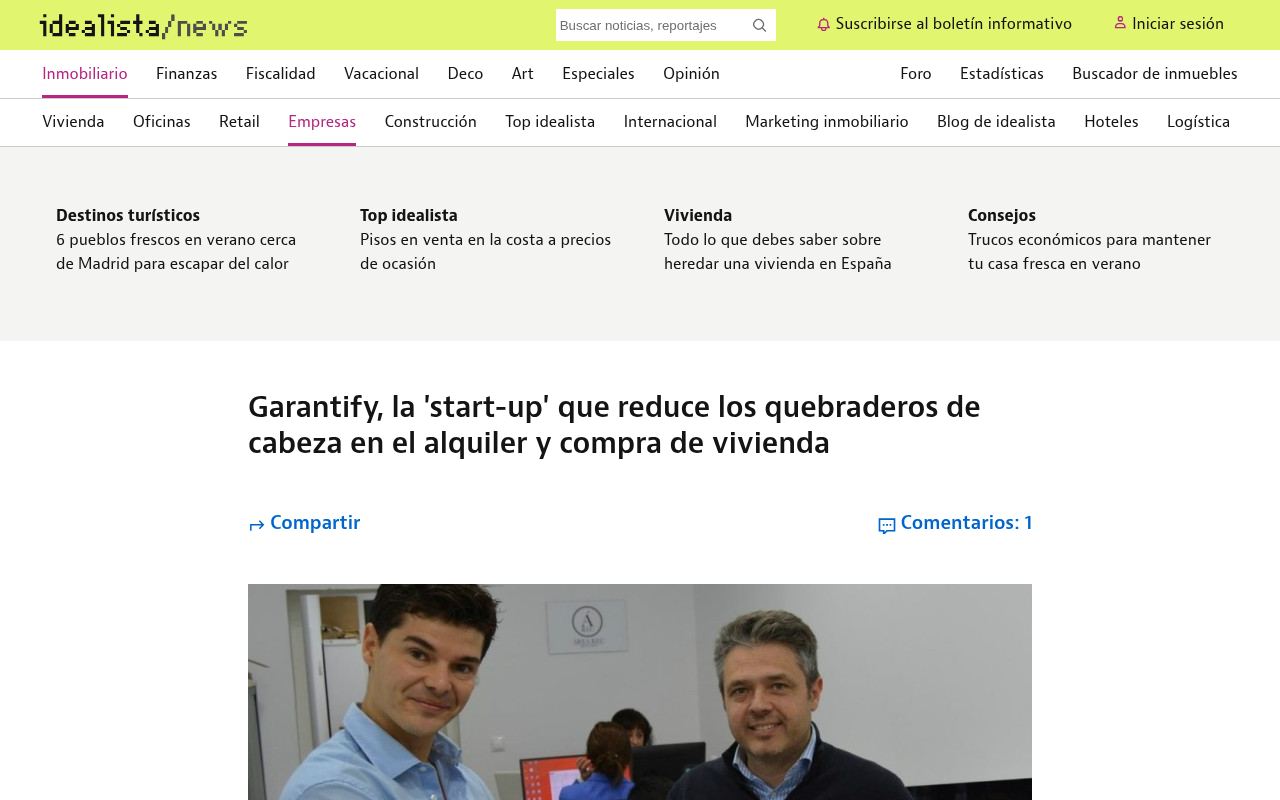
What followed gave him his confidence back: finalists at BBVA Open Talent 2018, the bank’s fintech startup competition, an award at Finnovating #uProtech, and coverage in La Vanguardia, El País, El Mundo, Emprendedores and EFE. In January 2019, on idealista/news (the news arm of Spain’s biggest property portal), Garantify claimed 1,547 estate agencies as users. According to Vozpópuli it closed 2019 with close to €1.5 million in revenue and seven staff, and was looking to raise €10 million. Alongside it he launched Homesya, a property portal, and became a director of Molista Technologies, a real-estate CRM, once again connected to Luis Krug.
idealista.com/news24 Jan 2019
idealista/news, January 2019: “Garantify, the start-up taking the headaches out of renting and buying a home”.
agencies using it (2019)
1,547
agencies using it (2019)
2019 revenue, per Vozpópuli
~€1.5M
2019 revenue, per Vozpópuli
raised in total, per Sergi
~€500k
raised in total, per Sergi
BBVA Open Talent 2018
Finalist
BBVA Open Talent 2018
Garantify on “Emprende” (Spanish public TV, RTVE) · 2019 · in Spanish
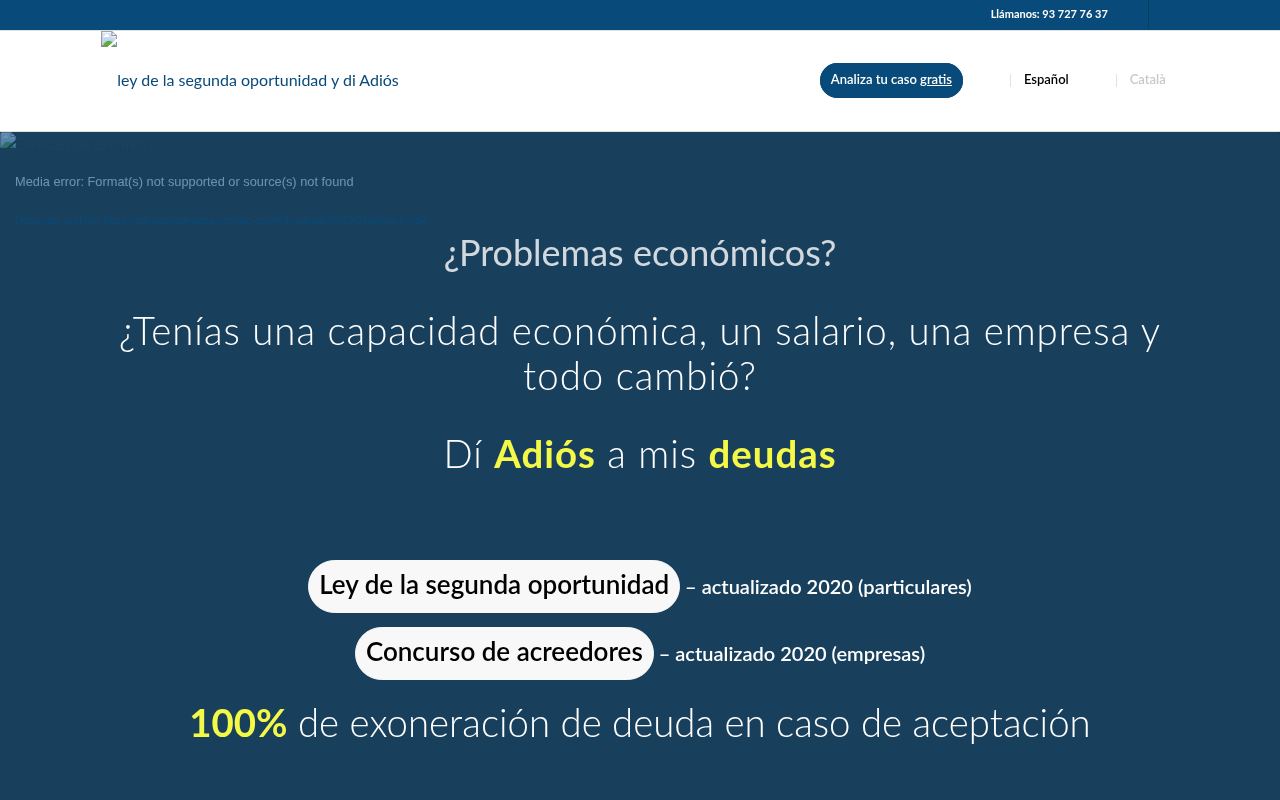
2019 saw the launch of Adiós a mis deudas (“Goodbye to my debts”), a service that helps people use Spain’s Second Chance Law, which lets individuals and sole traders who’ve gone broke have debts they can no longer pay written off, much like a bankruptcy discharge in the UK, the US or Australia. The company was founded by Jordi Pardo and Sergio Gonzálvez, his Garantify partner, with the law firm Aran Advocats. The website used Garantify’s legal copy. Sergi listed it on his Facebook as one of his projects and shared it on Twitter in January 2020: “Have you heard of it? The second chance law.”
In February 2021 the firm announced it had written off more than €2 million of debt for its clients in two years. Someone who had lived through an insolvency ending up close to a second-chances business fits this story rather well.
adiosamisdeudas.com22 May 2020
Adiós a mis deudas: Spain's Second Chance Law explained so anyone can follow it.
The pandemic filled the internet with Shopify stores, and Sergi spotted the gap: checkout, the final step of a purchase and the one where the most sales are lost. He founded Shopipay, a “customisable one-step checkout with one-click upsells for Shopify”, priced from US$29 to US$199 a month. The first testimonial on the site was his own, as a store owner: “I’ve increased my average order value by 20%.”
shopipay.ioarchived 17 Feb 2021
Starter
US$29/mo
+1% per sale
Pro
US$59/mo
+1% per sale
Scaling
US$199/mo
+0.5% per sale
“Ready to make your sales take off?” One-step checkout for Shopify, more than 160 payment gateways, A/B testing and one-click upsells. Pricing as shown on the archived site. See the capture
Behind it were two companies set up in 2020. Ecom Apps S.L. in Valencia, with Gerard Usero (a trainer in cash-on-delivery ecommerce), David Barberà and Eduardo Morant. And The Ecommerce Space S.L. Its servers were processing real stores from June 2020. Shopipay was eventually renamed ShopWin and went on to advertise more than 2,000 checkouts and more than €2.5 million processed.
On 28 April 2022 Emprendedores, one of Spain’s best-known magazines for founders, invited him to a panel at Casa SEAT in Barcelona and introduced him as “a serial entrepreneur, founder of Shoppipay (ShopWin), an app for automating sales, and currently setting up a cryptocurrency investment fund”. There he said: “If you give users power, they’ll create content.”
An entrepreneur is also what he does when he isn’t building. His public trail leaves these stamps in the passport:
February 2009Ecuador“A coffee in Ecuador: 25 cents”
June 2009TenerifeA short break, then a TV interview on a Madrid stopover
September 2010Lloret de MarChairing a panel at COMITUR
October 2019AlicanteWhere Garantify had its office
June 2022San Blas, PanamaFranklin Island
June 2026BaliWhere FlexRoute was born
It also shows someone who tries every new thing before anyone else, crypto included. In 2021 his tweets are about DeFi on Binance Smart Chain: Beefy “working like crazy”, StudentCoin “a bit stalled”, and the lesson about opportunity cost: “the downside is you lose the opportunity cost.” On 30 August 2021 an exploit during an NFT game’s migration took his characters with it: “Lost all my #bmars in the migration exploit attack… can you return my dragons? 😢” (that one he wrote in English). By spring 2022 he was talking publicly about setting up a crypto investment fund.
“80% of what worries us NEVER actually happens. Enjoy the ride.”
Twitter @sergirodriguez, 10 July 2022
Sources: Twitter @sergirodriguez as archived on the Wayback Machine (2009, 2012, 2019–2022) · blog, July 2009 and September 2010
VI
Part VI · The resurrection · 2024–2026
Sergio de la Rosa
At 42 he takes a new name to work under, goes back to coding every day and turns the first piece of advice he ever gave, back in 2009, into his job: automate.
Chapter 15 · 2024 – 2025
The developer who came back
On 14 May 2024, almost nine years after “Getting hungry again”, sergirodriguez.com published a new post: “How artificial intelligence can help people who sell services.” It was aimed at massage therapists, osteopaths and hairdressers, and talked about bookings, reminders and chatbots. It looks like nothing much, but it’s the first sign of the comeback.
Soon after, his LinkedIn, the same /in/sergirodriguez he’d had since 2009, was renamed Sergio de la Rosa. Out came sergiodelarosa.online, “technology consultant and AI specialist”, and the YouTube channel @sergiodelarosa_ia, with around 200 videos on AI tools; he uploaded about 84 in October 2025 alone. On Instagram, @spnfury became “Sergio de la Rosa | I make money with AI”.
“Automate: try to automate most of your company’s day-to-day processes, so they take up as little of your time as possible.”
He builds AI voice receptionists that answer calls, book appointments and handle questions, wired into the software each sector already runs on: Doctoralia for clinics, CoverManager for restaurants, QVET for vets, Witei for estate agents (the Spanish equivalents of the booking and practice-management systems businesses use everywhere). He set up automated voice-AI calls to leads (Setter IA), a course on making UGC-style videos with AI with its own student area, and SellTok, an agency for TikTok Shop. In March 2025 he ran a webinar for the C4E club on selling through TikTok Shop, billed as an “expert AI consultant”.
In June 2025 he was interviewed on “Meraki”, a show about marketing and talent, on AI for business. In his classes he introduces himself like this: “I’ve spent 20 years in digital founding startups, and four years in artificial intelligence.”
Everything about AI for business (“Meraki”) · 17 June 2025 · in SpanishAI and the comeback of forgotten ideas · 3 October 2025 · Sergi revisits Onyougo, the barcode-scanning app, and how AI would make it far easier today (in Spanish)
Fifteen years after Oooferton he’s back in live shopping, the real thing this time: on video, and live.
In September 2025 he sat down with POVCA$H, a founders’ podcast run by two young hosts, to talk about TikTok Shop. He ended up doing something he’d never done in twenty years of blogging: telling all of it. For an hour and a half he went through the numbers, the times he went broke and the betrayals.
How to sell on TikTok Shop, with Sergio de la Rosa · POVCA$H · 18 September 2025 · 1 h 39 min · his most biographical interview (in Spanish)
The betrayal. Asked what split his life into before and after, he didn’t talk about a business:
“I’ve been fired from my own company. At a shareholders’ meeting I’d walked into full of enthusiasm: ‘Sergi, could you step out of the room for a moment? We’re going to vote.’ Emotionally, it destroyed me.”
He doesn’t say which company it was or who voted, and neither will this page. He does say what he learnt: there were eight shareholders, he’d brought several in “without them putting in capital, in exchange for work or advertising”, and now he looks at everything “with eight eyes”. “A company is like a table: you need four balanced legs. Don’t fill your company with eight partners, because afterwards it turns into Game of Thrones.” And what he values most in a partner today: “not so much their skills as whether they’re a good person.”
Going broke. Asked about his lowest moment: “I’ve gone broke several times. Pablo Motos used to say you don’t become a millionaire until you’ve gone broke three times… I’ve got one left.” (Motos hosts El Hormiguero, one of Spain’s most-watched TV talk shows.) Then he added: “Where I’ve suffered most is when I’ve been betrayed.”
Money.“I’ve made a lot of money and managed it very badly.” He says he lost “a huge amount” in crypto, “always chasing quick money: bots, trading, scalping”. Today he puts 10 to 15% of his income into Bitcoin every month, “like a religion”, and has come to see that “this is a marathon”. His best single day of revenue: €35,000, with an online store.
The regret. At the end, in a quick-fire round, he made a confession nobody had asked for:
“I deeply regret something I did about three and a half years ago: I promoted a crypto trading bot. A multi-level scheme. I got in because the money came in fast, and I wasn’t fully aware it wasn’t what it promised. I did warn people it was high-risk, but some people lost money they needed. That’s where I learnt that money that comes in fast goes out fast.”
Saying it in public, and posting that clip on his own channel, says as much about him as any of his wins. Seven months later he would start building his own bot, with a rule written down from day one: “learn, but don’t lose.”
In 2026 Sergi works like a one-person product studio, with AI as his team. More than fifteen products of his own share a single server, each with its own domain, database and history:
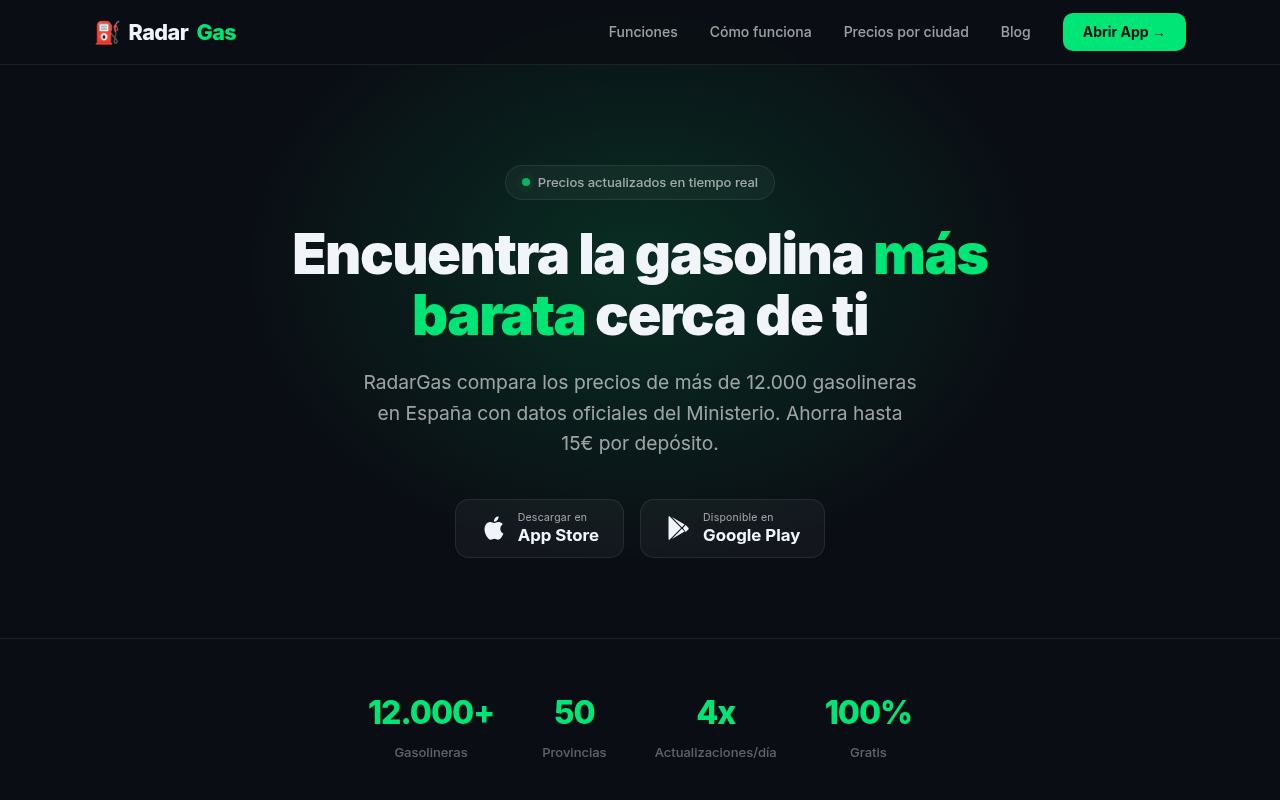
RadarGas and Gasolina Barata: the Onyougo comparison idea applied to more than 11,000 Spanish petrol stations, using official government data, with an iOS app.
MotionClone: a paid SaaS with real customers for cloning motion in video with AI, plus a Chrome extension.
Currofácil: a local jobs board with AI-generated CVs and video CVs.
PlanazosBCN: things to do in Barcelona, with Stripe pre-bookings and QR stickers in restaurants.
Money17: from an Amazon product to an AI-made YouTube video, automatically.
BrandPilot: white-label websites and landing pages for agencies.
Casinuevo, twenty years on, with Homesya as its property vertical in Mexico and Bali.
CodigoAmigo, Malprecio, IA Pasión, VideoForge, Fútbol en la Tele…
radargas.comSeptember 2026
RadarGas today: more than 12,000 petrol stations compared using official data. Onyougo's idea, twelve years later, applied to fuel.
In June 2026 he flew to Bali and went looking for a way home via Saigon or Bangkok. That search turned into another project, FlexRoute, a flight planner. That’s him all over: a trip becomes a product.
Chapter 18 · April – September 2026
The bot that never won (and what it taught him)
The hardest test of 2026 has no customers. It’s a crypto trading bot called Cryptorico that trades perpetual futures. Sergi started it on 12 April 2026 with a simple goal, “a profitable, stable bot”, and an honesty that’s rare in that world: “I have no idea about trading.” His rule: “learn, but don’t lose.” To this day he has never put real money at risk. Everything has run on a demo account or in simulation.
The bot’s story repeats the story of his whole life:
April–May: trading the news. The bot reads the news and opens positions. After six weeks comes the “total cull”: the trades were landing after the move. There was no edge. Along the way, 307 “ghost closes” in two and a half hours, a heavily leveraged bitcoin short triggered by news about a different coin, and three days stalled without anyone noticing.
June: trend-following. An audit found that two-thirds of the losses were fees. They tested 4-hour and daily timeframes. The decision: daily trend only, with a kill rule written down before seeing the results.
June–July: scalping and order flow. Moving-average crosses, Bollinger bands, CVD, funding rates, VWAP, carry, pairs. All of it died. A strategy that won 100% of the time over 8 trades lost over 470. That gave him his first recorded lesson: “n=8 lies”. And another: on the big coins, fees eat any weak edge.
July–September: the strategy factory. Whole generations of configurations (109, 170, 98, 50…), more than 450 in total, tested against a “dead control” and 40 runs of coin-tossing. None of them beat chance in any provable way. On 12 September 2026 the prediction programme was shut down: proving an edge of 0.15% per trade would take more than two years of data.
“Moving a threshold after seeing the result is how this project fooled itself about 450 times.”
Project documentation, August 2026
It’s a financial failure with no losses, and probably the best school he’s ever had. That bot gave him the rules he now applies to every product:
of real money at risk
€0
of real money at risk
configurations tested
450+
configurations tested
that beat chance
0
that beat chance
thread still alive: altcoin market making
1
thread still alive: altcoin market making
∞
Epilogue · Return with the elixir
What’s left after falling so many times
In the hero’s journey, the adventure ends when the hero comes home with something that helps others. Twenty years after mortgaging his flat, what Sergi brings back is a set of rules learnt the hard way:
1Enthusiasm, persistence and unshakeable faith in what you do.His answer in 2009 to what a founder needs. Seventeen years on, it hasn’t changed.
2Niche down.Radarprice started with 8 million products and only became App of the Week once it focused on nappies.
3Focus beats spreading yourself thin.Running three companies at once cost him his 21% of Oooferton just before it was worth millions.
4Downtime isn’t the enemy of performance.“That free time is when I’ve had my best ideas.” March 2010.
5Fear is your worst enemy.He wrote it in 2015, on his way out of the darkest stretch.
680% of what worries us never happens.July 2022.
7n=8 lies.Learnt in 2026 from a bot that never won. It applies to trading, startups and life.
8Be careful who you let into your company.Learnt when he was voted out of his own at a shareholders’ meeting.
9Automate.The first piece of advice he ever gave, in 2009, is now his job.
Today he goes by Sergio de la Rosa and helps businesses use artificial intelligence to automate what took him twenty years to learn to do by hand. On GitHub he’s still spnfury. Say hello on LinkedIn →
Appendix A
Full timeline
Born near Barcelona.
Technology-track high school and two higher vocational diplomas in IT (Escola del Clot, IES La Ferreria).
Codes the first version of oh-holidays.com.
Network technician at Kalise Menorquina, freelance work, then developer at Open House Spain.
Joins Desig Barcelona as project manager. Gets it ranking for “apartamentos barcelona” in 9 months.
First listings on casinuevo.net.
Buys 50% of Desig by mortgaging his flat.
Sets up Cyberworld Networks S.L. (Casinuevo, plus versions for Mexico and Latin America).
First Iniciador Barcelona meetup.
Trip to Ecuador.
Oferton Liveshopping S.L. is incorporated.
Launches oooferton.com with Luis Krug, as co-founder and CTO.
New office at Carrer de Llull 393.
Interview with Rodolfo Carpintier on Baquía TV.
265 orders in one day on Oooferton.
Presents Cladoo for Latin America. Covered by Loogic.
Running three companies: Desig (8 staff), Cyberworld and Oooferton (€100k a month).
Sells his 21% of Oooferton, “forced to”. Best month in Desig’s history.
A blog network, and a sale of Cladoo shares.
Chairs a panel at COMITUR, Lloret de Mar.
Eighteen months without blogging. Founds R Que R 17 (Onyougo) and Diva Loca S.L.
Onyougo launches as a social network for electronics.
The desigbarcelona.com website is sold. Central de Reservas Desig enters insolvency proceedings.
Launches the “unbribable” price comparison site.
€100,000 round with Antai, Risto Mejide, Marc Ros, Axel Serena, Vicente Alán and Carlos Blanco.
A court dissolves Central de Reservas Desig.
Onyougo is renamed Radarprice.
“Getting hungry again, steering clear of fear”.
Steps down as a director of Onyougo Dreams.
Authorised representative of iStocks Company S.L.
Co-founds Garantify with Sergio Gonzálvez, as CTO.
BBVA Open Talent finalist. Director of Molista Technologies.
Garantify: 1,547 agencies using it (idealista/news).
Adiós a mis deudas launches. Garantify turns over close to €1.5M.
Ecom Apps S.L. Shopipay processes its first Shopify stores.
The Ecommerce Space S.L.
DeFi and crypto. Loses his #bmars in an exploit.
Emprendedores panel at Casa SEAT: “setting up a cryptocurrency investment fund”.
Trip to San Blas, Panama.
The blog returns, this time about artificial intelligence.
The Sergio de la Rosa brand is born: AI consulting, YouTube, voice receptionists.
TikTok Shop webinar for C4E.
Interview on “Meraki” about AI for business.
Tells it all on the POVCA$H podcast: going broke, being betrayed by partners and the multi-level bot he regrets.
Starts Cryptorico, his trading bot.
Trip to Bali. FlexRoute is born.
Shuts down the bot’s prediction programme: no strategy beats chance.
More than fifteen products of his own, and the story you’re reading.
Appendix B
Sources
Traffic, user and revenue figures for his own projects between 2009 and 2013 were published by Sergi himself, on his blog and LinkedIn, at the time. Company roles come from Spain’s Companies Register (the Registro Mercantil, Spain’s equivalent of Companies House or ASIC). Everything else links to press coverage or Wayback Machine captures. Almost all sources are in Spanish; titles are translated here so you know what you’re clicking.